
India, with its demonstrated capabilities of undertaking low cost high value inter-planetary travel, offers great opportunities for NASA to work with.

The spacecraft is expected to reach Mars orbit in about 200 days from now and then begin its mission to study the Red Planet's atmosphere.

The US space agency NASA is planning an ambitious mission involving international scientists to explore the possibility of life on Europa, the moon of planet Jupiter.

The National Aeronautics and Space Administration's planet-hunting Kepler spacecraft which is carrying out a new mission has made its first exoplanet discovery -- a 'super-Earth' located 180 light-years from Earth.

The National Aeronautics and Space Administration plans to send solar-powered airships to explore Venus' atmosphere and to eventually establish a permanent human colony in a floating cloud city above the Earth's nearest planetary neighbour.

Aditya-L1, the first space-based Indian observatory to study the Sun, is getting ready for its launch soon, ISRO said on Monday.

After the historic success of its Chandrayaan-3 lunar mission, Indian Space Research Organisation (ISRO) is going full throttle with its plans to send Indian astronauts for the first time to the Moon by 2040, ISRO Chairman S Somanath said.
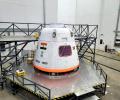
Modi gave these directions during a meeting to review the preparedness of the Gaganyaan mission and the first demonstration flight of the crew escape system test vehicle scheduled for October 21.

'Its nature changes, new types of jobs are created.' 'We need to invest in skilling and re-skilling our people for an AI-driven future,' Prime Minister Narendra Modi said in his opening speech at the AI Action Summit in Paris, co-hosted by India.

ISRO chairman S Somanath said the success gave the space agency "greater confidence," as the GSLV will be next deployed in the NISAR mission, a collaborative effort with the US' NASA.

Observing that climate change has become an urgent concern across the globe, Prime Minister Manmohan singh said on Friday ways and means should be developed to reduce India's carbon footprint as it would be among the nations to be 'most seriously' impacted.

The Indian Space Research Organisation (ISRO) is set to welcome the new year with the launch of its first X-Ray Polarimeter Satellite that would offer insights into celestial objects like black holes, onboard a Polar Satellite Launch Vehicle rocket on Monday.

India and the US on Friday said they have started talks to put in place a strategic framework for human space flight by year-end as they plan to send an Indian astronaut to the International Space Station in 2024.

India supports dialogue and diplomacy and not war, Prime Minister Narendra Modi said at the Brazil, Russia, India, China, South Africa (BRICS) Summit in Kazan, Russia on Wednesday, in an unambiguous message calling for resolution of the Russia-Ukraine conflict through peaceful negotiations.

Luna-25 may land on the lunar surface earlier than Chandrayaan-3.

Scientists at ISRO used the orbiter high resolution camera onboard the Chandrayaan-2 orbiter to study the lunar surface hours before and after the soft-landing of Vikram lander on the moon on August 23.
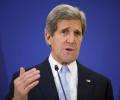
The US is keen to improve business ties with India.

The Indian Space Research Organisation has resolved to alight its lander on the lunar surface with Chandrayaan-3 in addition to a maiden solar expedition in 2020.
The government on Thursday allowed free inter-state wheeling of renewable energy used in the production of green hydrogen and ammonia as it seeks to boost usage of the carbon-free fuel and make India an export hub. Unveiling the first part of the much-awaited National Hydrogen Policy, Power and New and Renewable Energy Minister Raj Kumar Singh said the government is targeting production of 5 million tonnes of green hydrogen by 2030. Oil refineries to steel plants require hydrogen to produce finished products.

India's Mars orbiter craft has completed eight years in its orbit, well beyond its designed mission life of six months. Plans on a follow-on 'Mangalyaan' mission to the Red Planet, however, are yet to be firmed up.
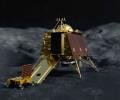
ISRO on Friday said it has made efforts to establish communication with its lunar mission Chandrayaan-3's lander Vikram and rover Pragyan to ascertain their 'wake-up condition' after they had been put into sleep mode early this month -- but no signals have been received from them as of now.

India is now on the Moon and the success of the lunar mission has sounded the bugle for the emergence of a developed nation, Prime Minister Narendra Modi said on Wednesday as Chandrayaan-3 landed successfully on the lunar surface.

Elections are not won or lost by expounding on such macro-economic matters. For the aam admi, what matters in manifestos are promises that will improve their quality of life, notes Vinayak Chatterjee.
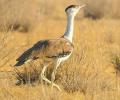
The Great Indian bustard is at the centre of another impending legal tussle. The government is planning to move the Supreme Court seeking a review of its order that asked Gujarat and Rajasthan to lay transmission lines linked to solar power units underground so as to not pose any threat to the endangered bird. The ministry of new and renewable energy (MNRE) has sought a view from the law ministry and will move the court basing its arguments on estimates showing that the bird's population was declining even before solar power plants came to the region, said a senior government official requesting anonymity.
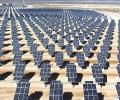
The idea is to set up renewable energy generation capacity, including both solar and wind, along with the associated evacuation infrastructure, at a mega scale in the four Indian deserts -- Thar in Rajasthan, Rann of Kutch in Gujarat, Lahul & Spiti in Himachal Pradesh and Ladakh in Jammu & Kashmir.
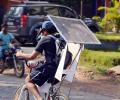
Sushil Reddy took a seven day trip to spread awareness on solar power.

Here's the full text of address to the nation by President Droupadi Murmu on the eve of the Republic Day 2023.
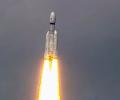
The Chandrayaan-3 mission that aims for a soft landing on the moon's surface, paving the way for future interplanetary missions, carries six payloads that would help ISRO understand the lunar soil and also get the blue planet's photographs from the lunar orbit.

Prime Minister Narendra Modi on Tuesday said India will become the growth engine for the world in the coming years, and the ease of doing business has improved with "mission-mode" reforms being undertaken by his government. Speaking at the BRICS Business Forum Leaders' Dialogue in Johannesburg, Modi also said India soon will become a $5 trillion economy.

Aditya-L1 is the first Indian space-based observatory that will study the Sun from a halo orbit around the first Sun-Earth Lagrangian point (L1), which is located roughly 1.5 million km from the Earth.

The Trans-Lagrangian Point 1 Insertion manoeuvre marks the beginning of the spacecraft's about 110-day trajectory to the destination around the L1 Lagrange point, a balanced gravitational location between the Earth and the Sun.

After witnessing cloudy skies this year, the country's renewable energy sector is expected to boom with a likely investment of over $15 billion in 2022 as the government focuses on electric vehicles, green hydrogen, manufacturing of solar equipment as well as achieving the ambitious 175 GW renewable capacity target. India, which has an installed renewable energy generation capacity of a little over 150 GW, aims to reach 175 GW in 2022. Out of the total mix, 100 GW would be from solar, 60 GW from wind, 10 GW from bio-power and 5 GW from small hydro power projects.
Solar Orbiter is on a unique trajectory that will allow its comprehensive set of instruments to provide humanity with the first-ever images of the Sun's poles, the US space agency said. This trajectory includes 22 close approaches to the Sun, bringing the spacecraft within the orbit of Mercury to study the Sun, and its influence on space, it said.

Readers have responded resoundingly to our invitation to congratulate the ISRO team for Chandrayaan-3's successful Moon landing.

Rediff.com takes a look at spacecraft that have successfully made it to Mars.

All progress in space should excite us and encourage us to be optimists about a better future for our planet and all of us, asserts Aakar Patel.

It has already tasted success with the moon mission and Mangalyaan. Is man in space the next frontier for ISRO?

The rover will carry out in-situ chemical analysis of the lunar surface during the course of its mobility.

Prime Minister Narendra Modi made a pitch for electing a strong and stable government in an uncertain world beset by geopolitical tensions as the Bharatiya Janata Party on Sunday released its manifesto, prioritising development and welfare while shunning populist measures and contentious issues like the National Register of Citizens (NRC).

The mission objective is to ensure data continuity of ocean color and wind vector data to sustain the operational applications.
